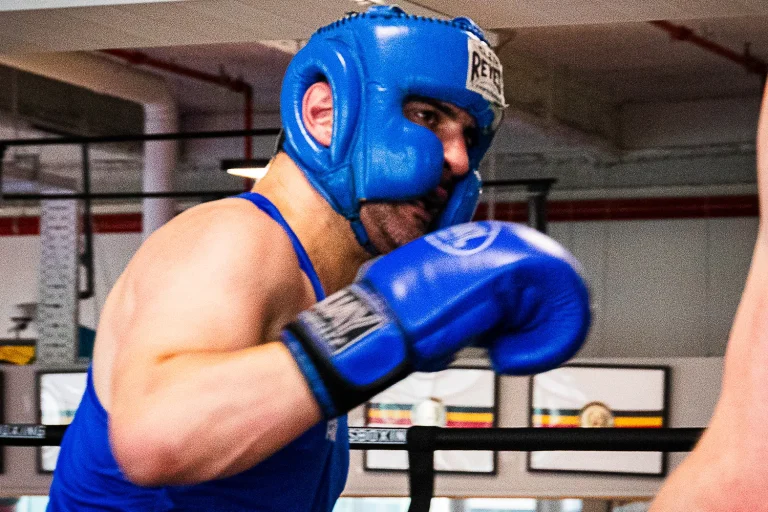





Want to box professionally and become a pro boxer in Brussels? Training, more training, and above all passion! If you have always dreamed of stepping into the ring and competing at the highest level, this article is for you. But be warned: the road to the top is long and full of obstacles. As well as raw strength and physical toughness, boxing demands strategy, technique, perseverance and unshakeable willpower.
How do you become a professional boxer?

Do you dream of a career in professional boxing and fighting your way to the top? Becoming a professional boxer takes much more than powerful punches and good fitness. It also requires specific skills, unwavering determination and rigorous preparation.
To become a professional boxer, it is essential to follow certain key steps. First of all, you need to train regularly and get to know the different types of boxing training. Next, it is important to develop your technical, tactical and mental skills so that you can compete in the ring.
A professional boxer’s career comes with both rewards and challenges. On the one hand, you will have the opportunity to live your passion every day and be right at the heart of the action. On the other hand, you will face constant pressure to perform and the risks inherent in this demanding sport.
If you are ready to devote time and relentless effort and to push your limits day after day, then perhaps you have what it takes to succeed in the ruthless world of professional boxing.
Training programme to progress in professional boxing
Planning an effective professional boxing training programme is essential for developing your skills and reaching your goals. It is important to strike a balance between technical and physical training in order to progress optimally in this demanding sport.
When creating a boxing training programme, several aspects need to be taken into account:
- Goals: Define your specific goals, whether that is improving your fitness, perfecting your technique or preparing for a fight. This will help you structure your programme and focus on the key areas.
- Kickboxing vs English boxing: Choose the type of training that best suits your preferences and abilities. Kickboxing places more emphasis on kicks, while English boxing focuses mainly on punches. Depending on your choice, adapt the exercises and drills accordingly.
- Technical training: Dedicate part of your week to technical training to improve your punching, slipping and movement skills. Work with experienced coaches who can give you valuable advice to refine your style.
- Physical training: Don’t neglect the physical side of your programme. Build your cardiovascular endurance with intensive sessions such as heavy bag work, skipping rope and circuit training. Also work on your strength and explosiveness with suitable strength exercises.
- Training partners: Find training partners of a similar level so you can challenge each other. Organise sparring sessions to put your techniques into practice and develop your game in real situations. A good partner will help you improve exponentially and propel you towards professional boxing. Naturally, that partner needs to have a winning mindset!
- Weekly planning: Draw up a weekly training schedule that takes your other commitments into account.
General physical training for boxing
To become a good boxer, it is essential to follow different types of boxing training. One of the most important is general physical training. Here are a few key points to keep in mind:
- Basic exercises to improve your boxing fitness: To build your endurance and strength, you can include exercises such as push-ups, squats, burpees and lunges in your training. These exercises work several muscle groups and help you gain power and stamina.
- The importance of strength training in professional boxing: Strength training is crucial to being a good boxer. By working your muscles, you improve your punching power and your ability to absorb punches. Exercises such as bench presses, pull-ups and deadlifts are particularly beneficial for building muscle.
- How to develop speed, agility and coordination through physical boxing training: To improve these essential aspects of boxing, you can include specific exercises such as shadow boxing (boxing against thin air), sparring (practice fighting) and dynamic stretching. These activities help you refine your movements, improve your reactivity and optimise your coordination.
In conclusion, general physical training plays a crucial role in developing a boxer’s skills. By including basic exercises, strengthening your muscles and working on your speed, agility and coordination, you will be better prepared to face the challenges of the ring. Always remember to warm up properly before every training session in order to reduce the risk of injury, and make sure you follow a training programme suited to your specific needs.
Cardio exercises for professional boxing

Cardiovascular exercises are essential for boxers, as they help improve endurance and breathing capacity. Here are a few exercises specific to professional boxing that can help you reach your goals:
- Skipping rope: This classic exercise is ideal for working on your heart rate and coordination. Try different variations, such as skipping on one foot or crossing your arms.
- Shadow boxing: By simulating a fight against an imaginary opponent, shadow boxing lets you build your endurance while perfecting your punching technique. Feel free to add footwork to increase the intensity.
- Punching bags: Hitting a punching bag is not only a great way to release stress, but also an effective way to improve your fitness. Alternate between fast, powerful sets and longer sets to build strength and endurance.
- Circuit training: Circuit training combines different cardiovascular exercises such as burpees, jumping jacks and mountain climbers. By performing these exercises in quick succession, you work your whole body and increase your cardiovascular capacity.
To maximise the benefits of these cardio exercises, it is recommended to adapt the intensity and duration of your sessions to your training level:
- Beginners: Start with 20 to 30-minute sessions twice a week. Gradually increase the intensity over time.
- Intermediate: Aim for 30 to 45-minute sessions three to four times a week. Add high-intensity exercises to improve your performance.
- Advanced: Go for sessions of at least 45 minutes, five times a week. Include high-intensity intervals to push your limits.
In conclusion, cardiovascular exercises are indispensable for boxers who want to improve their endurance and breathing capacity. By including these boxing-specific exercises in your training routine, you will be able to progress and reach your goals faster.
Strength training to improve your boxing performance
Strength training is essential for improving your performance as a boxer and progressing all the way to professional boxing. Here are a few key points to keep in mind:
- The key muscles to work: To become a better boxer, it is important to target the specific muscles used in fights. These include the arm muscles, such as the biceps, which are engaged when punching. By strengthening these muscles, you will be able to hit harder and faster.
- Using body weight or specific equipment: There are different ways to strengthen these muscles. You can use your own body weight by doing push-ups, pull-ups and dips. These exercises effectively work the upper-body muscles. In addition, using specific equipment such as the punching bag also helps strengthen the muscles used in fights.
- Recommended frequency and volume: For the best results, it is important to adopt an appropriate training frequency and volume. In general, it is recommended to train at least three times a week to give your muscles time to recover between sessions. Varying the exercises and loads will also help you avoid stagnation and keep improving your performance.
In conclusion, strength training plays a crucial role in improving boxing performance. By working the key muscles used in fights, using body weight or specific equipment, and following an appropriate training frequency and volume, you can maximise your performance in the ring. Don’t forget to give your body the nutrients it needs to support muscle growth and recovery. So get ready to give it your all in your next fights!
Basic punching techniques and repetition

Essential punching techniques are the key to success in this demanding sport. By regularly practising the basic movements, you can perfect your technique and improve your performance in the ring.
Repetition is a crucial element in developing the skills needed for boxing. By repeating punch combinations over and over, a boxer can sharpen their reflexes, rhythm and accuracy. It also improves coordination between the different parts of the body involved in punching.
When practising punching techniques, it is important to focus on accuracy and speed of execution. Precise, fast punches can unsettle an opponent and increase your chances of success in a fight. Regular practice also helps you develop greater explosiveness when punching.
To maximise the effectiveness of training sessions, it is recommended to include specific exercises designed to improve your reaction speed to your opponent’s movements. These exercises can include simulated fights with a partner or using punching bags to work on different punch combinations.
Beyond the technical aspects, it is essential to pay particular attention to recovery after every intense training session. Proper rest allows the body to regenerate and supports the muscle development needed to punch with power.
In conclusion, the different types of professional boxing training, such as repeating punching techniques, combinations and fight tactics, are essential for improving a boxer’s skills. Regular practice helps perfect technique, improve the accuracy and speed of punches, and develop quick reflexes and greater explosiveness. So don’t hesitate to train hard and focus on these key aspects to reach your best level in this exciting sport.
HIIT training to improve your boxing fitness
HIIT (High Intensity Interval Training) is one of the different types of boxing training and offers many benefits. It improves fitness in an efficient and intense way. Here is how to structure a boxing-specific HIIT session, along with the exercises recommended for developing power and explosiveness.
The benefits of HIIT in boxing training
- Improves anaerobic endurance: HIIT puts intense demands on the cardiovascular system, which improves the endurance needed in fights.
- Increases muscle power: High-intensity exercises work the muscles explosively, building their power.
- Promotes weight loss: HIIT is known for its effectiveness at burning fat, helping boxers reach their ideal weight class.
- Boosts motivation: The high intensity of HIIT challenges physical and mental limits, driving greater motivation.
How to structure a boxing-specific HIIT session
- Dynamic warm-up: Do joint mobility movements and light cardio exercises to prepare your body for intense effort.
- Exercise circuit: Alternate short periods of intense exercise (for example, 30 seconds) with periods of active recovery (for example, 15 seconds).
- Boxing-specific exercises: Include boxing movements such as uppercuts, hooks and jabs to work the muscles used specifically in fights.
- Reps and timing: Complete several rounds of the exercise circuit, sticking to the time set for each exercise and recovery period.
- Cool-down: Finish the session with stretching to aid muscle recovery.
Conclusion: How to train effectively to progress in boxing?
To progress effectively in boxing, it is essential to follow a training programme suited to your needs. General physical training will help you build strength and endurance, while boxing-specific cardio exercises will improve your ability to maintain a high pace during fights. Strength training is also crucial for improving your boxing performance.
When it comes to punching techniques, repeating the basic movements is paramount. By practising these punches regularly, you will gain accuracy and power.
HIIT (High-Intensity Interval Training) can be very beneficial for improving your overall boxing fitness. This type of intense training alternates periods of maximum effort with periods of active recovery, developing both cardiovascular and muscular endurance.
In summary, to progress effectively in boxing, it is important to combine different types of training, such as strength training, boxing-specific cardio and HIIT. Don’t hesitate to consult a professional coach or a boxing club for personalised advice and to reach your goals faster.
Join us
Ready to take your English boxing to the next level? Join us at our boxing gym in Brussels! Sign up now and you can enjoy a free first training session. You will be guided by our best coaches. Don’t wait any longer, get in touch on +32 473 29 42 99 or via this contact form! You will find us in the Mint gallery in Brussels.
FAQ
Q: How many times a week should you train to progress in boxing?
It is recommended to train at least three times a week to progress in boxing. However, the frequency and length of your sessions may vary depending on your level of experience and personal goals.
Q: Should you focus on physical or technical training in boxing?
It is essential to strike a balance between physical and technical training in boxing. The two are complementary and both help improve your overall performance in the ring.
Q: What are the benefits of HIIT training for boxing?
HIIT training offers boxers many benefits, including a significant improvement in fitness, a faster metabolism, better tolerance of intense effort and quicker weight loss.
Q: What are the key skills to develop to perform well in boxing?
The key skills to develop in boxing include coordination, speed, cardiovascular and muscular endurance, punching accuracy and the ability to anticipate your opponent’s movements.
Q: Do you need a personal coach to train in boxing?
Although a personal coach isn’t mandatory, having one can be extremely beneficial for progressing quickly and avoiding technical mistakes. An experienced coach will be able to guide you, correct your movements and help you reach your goals. Our coaches in Brussels will be delighted to take you under their wing.