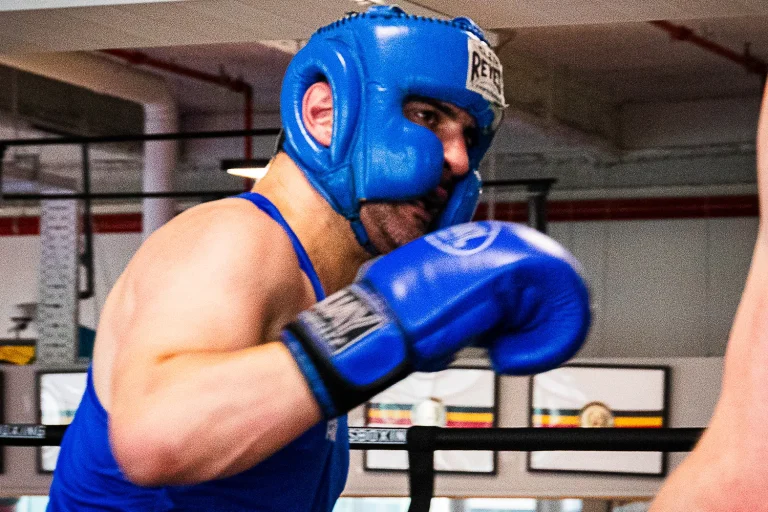





The hook in boxing, a powerful circular punch, is crucial for getting through the opponent’s guard and creating strategic openings. Combining power and technique, it stands out for its arcing path, targeting the sides of the head or body. Evolving along with the sport, the hook has gone from a crude swing to a refined manoeuvre that reflects a boxer’s skill and tactical finesse. Mastering it reflects not only physical strength but also a deep understanding of boxing strategy.
Hook Fundamentals
The hook, an iconic punch in boxing, relies on precise technique and correct body positioning. In this part, we break down the key elements for throwing an effective hook, with a focus on body position, rotation and balance.
Left and Right Hook Technique
The hook can be thrown with the left or the right arm. For a right-hander, the left hook is often faster but less powerful, ideal for catching the opponent by surprise. Conversely, the right hook, thrown with the rear hand, is slower but delivers more force. The key is to keep the elbow at the same height as the fist, ensuring a stable and powerful trajectory.

Body and Foot Positioning
A good hook starts with a good stance. Your feet should be shoulder-width apart, with the front foot turned slightly inwards. This position provides a solid base. When throwing the hook, your body weight shifts from the back foot to the front foot, which amplifies the power of the punch.
The Importance of Rotation and Balance
Body rotation is essential for an effective hook. By turning the hips and shoulders into the punch, the boxer generates extra force. Balance is just as crucial: a good boxer knows how to stay balanced while throwing a powerful hook, which keeps them ready for what comes next in the fight.
Types of Hooks and How to Use Them
The hook in boxing is not a single punch but rather a family of punches with different variations, each with its own strategic applications. In this section, we explore the different types of hooks and how they are used in a fight to get the most out of them.
Short Hook vs Long Hook
The short hook is fast and often used at close range. It is ideal for surprising an opponent when you are up close. The long hook, on the other hand, has greater reach and can be used to hit an opponent who is keeping their distance. Although it is slower, its power can be devastating when well executed.
Rising Hook (Uppercut) and Downward Hook
The rising hook, or uppercut, is a powerful upward punch aimed at the opponent’s chin or body. It is particularly effective against an opponent who drops their guard. The downward hook is less common but can be useful for reaching an opponent who is covering their face, by striking over the top of their guard.
Strategies for Using Hooks in a Fight
Every type of hook has its place in a boxer’s strategic toolbox. Which hook to use depends on several factors, such as the distance to the opponent, their stance and their fighting style. A skilful boxer knows how to switch between different types of hooks to keep the opponent on alert and exploit their weaknesses.
In conclusion, understanding the nuances between the different types of hooks and knowing when to use them is essential for any boxer. This knowledge not only makes your attacks more effective but also lets you adapt your strategy to the opponent and the situation in the fight. In the following sections, we look at training techniques to strengthen and refine these crucial punches.
Training and Improving Your Hook
Improving your hook in boxing takes focused, methodical training. This section concentrates on exercises and techniques that can build the power and accuracy of your hook, while integrating it effectively into your punch combinations.
Exercises to Build Hook Power
The power of a hook depends on the strength of the whole body, not just the arm. Exercises such as torso rotations, push-ups and weight training can increase upper-body strength. In addition, working on hip and shoulder rotation with specific exercises can significantly improve the power of your hook.
Training Techniques to Improve Accuracy
Accuracy is just as important as power. Using punching bags, focus mitts and speed bags can help sharpen the accuracy of your hook. These tools not only let you work on punch accuracy but also develop timing and coordination, key ingredients of an effective hook.
Tips for Working the Hook into Combinations
A hook should not be thrown in isolation. Working it into punch combinations can surprise the opponent and open up opportunities for further shots. Training should therefore include sequences in which the hook is combined with other punches, such as straights and uppercuts, to create fluid and unpredictable combinations.
In short, improving your hook in boxing comes down to rigorous training focused on strength, accuracy and strategy. By developing these aspects, a boxer can make their hook not only more powerful and accurate but also better integrated into their overall fighting style. The following sections cover how to defend effectively against hooks and strategies for countering them.
How to Defend Against a Hook

Defending effectively against a hook in boxing is just as crucial as knowing how to throw one. This section explores defensive techniques, the importance of reading your opponent, and exercises to improve your reflexes and your counter-attack against a hook.
Blocking and Evasion Techniques
Blocking and evading are the fundamental responses to a hook. To block a hook, it is essential to raise the arm on the side being attacked, keeping the glove close to the head to absorb the impact. Evasion requires a fast, precise body movement, often ducking or moving sideways, to avoid the punch. These movements need to be reactive and well timed.
The Importance of Reading Your Opponent
Anticipating a hook is a key skill. It means reading your opponent’s movements and habits. An attentive boxer can often see a hook coming by watching the opponent’s set-up, such as a repositioning of the feet or a particular shoulder movement. This anticipation lets you get ready to block or evade effectively.
Reflex and Counter-Attack Drills
Improving your reflexes to defend against a hook is essential. Exercises such as sparring, reacting to visual or auditory cues and partner drills can sharpen your reflexes. In addition, working on immediate counter-attacks after blocking or slipping a hook can give you a tactical edge, allowing you to regain the initiative in the fight.
An effective defence against the hook requires a combination of physical technique, careful observation and quick reflexes. By developing these skills, a boxer can not only protect themselves against this powerful punch but also create opportunities to fire back and take control of the fight. The next section focuses on analysing famous hooks in boxing history and what we can learn from these iconic moments.
Famous Hooks in Boxing History
Boxing history is full of moments where a well-placed hook changed the course of a memorable fight. This section looks at these historic punches and at the famous boxers known for their mastery of the hook.
Analysing Historic Fights
Some of the greatest fights in boxing have been marked by decisive hooks. By analysing these moments, we can see how the timing, accuracy and power of the hook were used to surprise the opponent and often to win the fight. These analyses reveal not only pure technique but also strategy and the ability to read an opponent, essential skills for any boxer.
Famous Boxers and Their Hooks
Several boxing legends are renowned for their devastating hooks. Figures such as Mike Tyson, Joe Frazier and Sugar Ray Leonard used the hook not only as a power punch but also as an integral part of their fighting style. By studying their fights, we can learn how these champions developed and refined their hooks, and how they built them into complex fight strategies.
The famous hooks in boxing history offer valuable lessons about the effectiveness of this punch. By studying these moments and these boxers, we can not only draw inspiration from their technique but also understand the importance of strategy, timing and reading the opponent in landing a successful hook. The next section covers safety tips and injury prevention to make sure your hook training stays safe and effective.
Ready to take your English boxing to the next level? Join us at our boxing gym in Brussels! Sign up now and you can enjoy a free first training session. You will be coached by our best trainers. Don’t wait any longer: contact us now on +32 473 29 42 99 or via this contact form ! You will find us in the Mint gallery in Brussels.