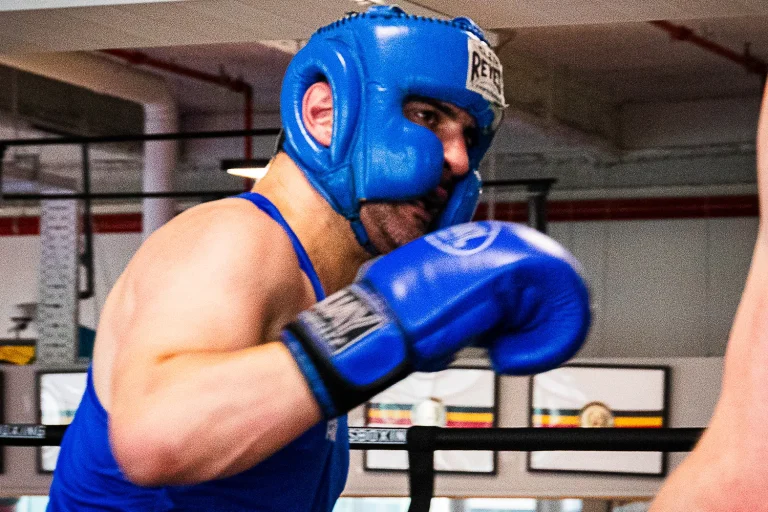





Boxing, nicknamed “the noble art”, is a discipline that blends history, technique and strategy. Born in the British Isles, it evolved from crude bare-knuckle fighting into a refined sport governed by precise rules and specific equipment. At the heart of the practice lies the art of the combination: a sequence of punches designed to surprise and unsettle the opponent. More than a simple show of strength, every movement in boxing is a tactical act, aimed at opening up the opponent’s guard and landing decisive attacks. In the ring, intelligence and precision are just as crucial as power.
The Fundamentals of Boxing
Stance and Guard
Picture yourself standing in the ring, feet firmly planted, body leaning slightly forward, ready to spring or slip. Your guard is your shield, your first line of defence against your opponent’s attacks. It must be solid and balanced, a true impenetrable fortress. But be careful: a guard is also an open window onto your intentions, a clue your opponent will try to decode. The key? Fluidity and adaptability: switching guards the way you switch tactics, with the subtlety of a chameleon.
The Six Fundamental Punches
Every boxer writes their own epic in the ring, but they all use the same alphabet: the six fundamental punches. These are the pillars on which the entire structure of boxing rests.
- The Jab (1): Lightning fast, it’s the probing shot, the opening line of the conversation, the punch that says “I’m here”.
- The Cross (2): Powerful and direct, a real hammer blow designed to shake the opponent’s confidence.
- Lead and Rear Hooks (3 and 4): The artists of the ring, able to get around the toughest defences and draw triumphal arches around the opponent’s guard.
- Lead and Rear Uppercuts (5 and 6): The uprisings, the rebels, punches that come from deep down to strike hard and high, exactly where the opponent least expects them.
Each punch has its own music, its own rhythm. Mastering them is like learning to play an instrument, where every note must find its place in the symphony of the fight.
Simple Boxing Combinations
With the foundations laid by the fundamentals, it’s time to build the first floors of our boxing structure. Basic combinations are a bit like the first dance steps you learn before tackling complex choreography. They’re simple, of course, but executed brilliantly, they can turn a novice into a virtuoso of the ring.
- Jab – Cross (1-2): The classic duo, the basis of every good combination. The jab clears the way, fast and sharp, creating a gap in the opponent’s defence. The cross follows, a heavy, determined punch ready to exploit the opening created by the jab. Together they form an elegant and effective combination, a true “hello” in the language of the noble art.
- Jab – Lead Hook (1-3): Here we add a touch of finesse to the dialogue. After the jab, instead of throwing a cross, you bring in a lead hook. This more circular punch wraps around the opponent’s guard, catching them off guard with its angle of attack. It’s the perfect combination for those who like to mix things up and surprise the person in front of them.
- Cross – Lead Uppercut (2-5): For thrill-seekers, this combination pairs the raw power of the cross with the surprise of the uppercut. The cross rocks the opponent, drawing their attention and their guard upwards, while the uppercut slyly slips into the space left open, targeting the chin or the body. A dynamic duo, ready to unsettle even the most stoic fighters.
Basic combinations aren’t just a matter of mechanics; they reflect a strategy, an intention. Each combination is a sentence in the story of the fight, each punch a word carefully chosen for its meaning and impact. Mastering these combinations is like learning the grammar of a foreign language. At first, you settle for building simple sentences, but those sentences are the foundation on which you build ever more complex and nuanced speeches.
Advanced Combination Techniques

Once you’ve mastered the basic steps of the dance that is boxing, it’s time to venture into more complex combinations, movements that tell a richer, bolder story. Advanced combination techniques are the equivalent of figures of speech in literature: they add depth, rhythm and a personal touch to the way you box.
The Subtlety of Feints and Slips
- Jab Feint – Cross – Lead Hook (F1-2-3): Here the feint plays a crucial role. By starting a jab without finishing it, you create anticipation, tension. Your opponent gets ready to parry or slip a punch that never comes, leaving openings for the cross and the lead hook. This combination is a real mind game, a question of timing and psychology.
- Cross – Slip – Rear Uppercut (2-S-6): In this combination, the slip is as important as the punches thrown. After a cross designed to engage the opponent, a quick slip lets you avoid their counter and puts you in the ideal position for a powerful rear uppercut. It’s the art of turning defence into attack, of making a slip an offensive move.
- Jab – Rear Hook – Side Step – Lead Uppercut (1-4-SS-5): This sequence shows the beauty of movement in the ring. The jab starts the action, the rear hook adds lateral pressure, but it’s the side step that really gets things going. By moving to the side, you create an unexpected angle of attack for the lead uppercut, a manoeuvre that demands as much agility as strategy.
Combination Strategies
In the boxing arena, every fight is a game of chess played at the speed of light, where combinations are your openings, your defences, your surprise attacks. Combination strategies aren’t just sequences of well-executed punches; they express how you read the fight and your ability to anticipate and react. It’s in this complex alchemy that victory is forged.
Adapting Combinations to Your Opponent
Every opponent is an open book, as long as you know how to read between the lines. Some are fortresses, unflappable and solid, while others are lightning bolts, fast and elusive. Your job? Choose the combinations that not only exploit their weaknesses but also neutralise their strengths. An aggressive opponent can be tamed with quick combinations and clever retreats, while a stubborn defender can be unsettled with feints and unpredictable attacks.
Using Combinations to Control the Ring
The ring is your kingdom, and combinations are your sceptre. With them, you dictate the pace of the fight and impose your will. By alternating between offensive pressure and strategic retreat, you can keep your opponent constantly off balance, hesitating between moving forward and backing off. It’s in that hesitation that you find your moment, your opening to strike with precision and efficiency.
Creating Openings with Combos
Combinations aren’t just tools of destruction; they’re also keys that open doors, opportunities to break through the opponent’s guard. A well-placed jab can be a question, to which an uppercut or a hook gives a stinging answer. Every punch in a combination has a purpose, whether it’s testing the defence, tiring the opponent or creating a chink in their armour. It’s by weaving these punches together with intention and intelligence that you can take apart even the most formidable opponent.
Common Mistakes and How to Avoid Them
In the breathless ballet of boxing, every dancer strives to perfect their choreography, to make each movement smoother and each combination sharper. But even in the finest performances, wrong notes can creep in: common mistakes that, if left uncorrected, can turn a symphony into a cacophony. Here’s how to spot these mistakes and, above all, how to avoid them.
Punching Without Precision
The most tempting mistake for a boxer is believing that brute force is the key to victory. Punches thrown with the full power of the body but without a surgeon’s precision are just hot air against a smart opponent. The Solution? Go back to the fundamentals. Work on your technique on the heavy bag and focus on the quality of every punch. Remember: one accurate jab is worth more than a flurry of hooks that hit nothing.
Neglecting Defence
In the heat of the fight, it’s easy to get carried away by the urge to attack and forget that every action has a reaction. Dropping your guard opens the door to your opponent. The Solution? Build defence into your combinations. After every series of punches, return to your guard position, ready to block or slip. Sometimes the best attack is a solid defence.
Predictability
Repeating the same combinations over and over can turn your strategy into an open book for your opponent. The Solution? Vary your combinations. Use feints, change your rhythm, throw unexpected punches. Surprise is a powerful weapon in the ring.
Lack of Flow
A combination isn’t a series of isolated punches; it’s a flowing cascade, where each movement follows naturally from the one before. Stiff, mechanical execution reduces the effectiveness of your attacks. The Solution? Practise shadow boxing in front of a mirror and focus on the fluidity of your movements. Let each punch lead into the next, like waves on the sea.
Want to dominate the ring? Join our boxing gym and turn potential into power. Our coaches are ready to lead you to victory, whatever your level. Take the first step towards greatness: sign up now and make every combination your signature move. Your legend starts here!