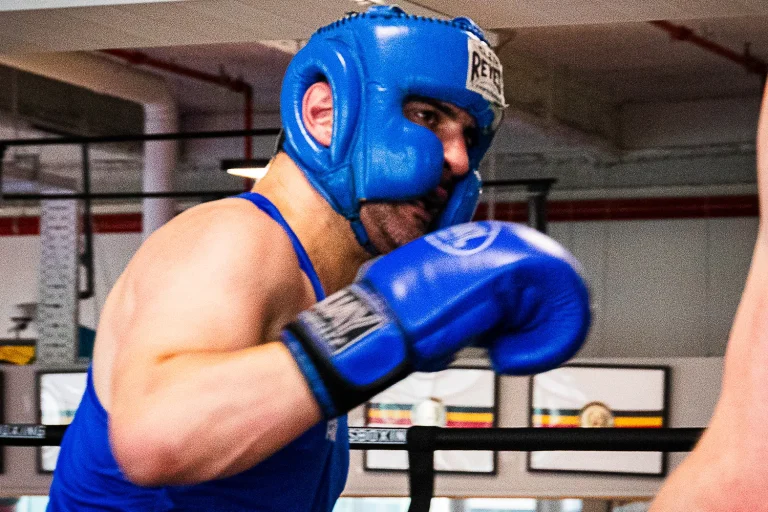





Boxing, often called “the noble art”, is a sport where strength meets strategy and agility. For a beginner, mastering the basic techniques such as the jab, the cross, the hook and the uppercut is essential. Each punch has its role: the jab to keep distance, the cross for power, the hook to get around the guard, and the uppercut to catch your opponent by surprise. More than a mere show of strength, boxing is a rhythmic and strategic art in which repeating and practising the fundamental movements is crucial for every aspiring boxer.
Stance and guard are the foundations on which everything else in boxing rests. As with a building, if the base is solid, the techniques can rise with confidence. In boxing, stance is not only a matter of physical positioning; it is also an expression of your state of mind, a mix of focus and readiness for combat.
Foot and Body Positioning
In boxing, your feet are your anchor. They determine your balance and your ability to move and react. A good stance starts with your feet shoulder-width apart. If you are right-handed, your left foot is in front, angled slightly, while your right foot is behind, providing stability and power. For left-handers, it is the other way round. This stance, neither too rigid nor too relaxed, allows optimal mobility, which is essential for slipping, stepping in or stepping back smoothly.
Keeping Your Guard: Hand Height and Chin Position
Your guard is your shield. Your hands should be high enough to protect your face, but not so high that they block your vision. Your elbows stay close to your body to protect your ribs and stomach. Your chin is tucked slightly, kept close to your chest, reducing the area exposed to your opponent’s punches. This posture creates a solid defence while letting you stay alert and ready to react.
The Basic Punches in Boxing
The Jab: Technique and Use

The jab is the cornerstone of boxing. It is the fastest and most direct punch, and often the first one you learn. For a right-hander, the jab is thrown with the left arm, and vice versa for a left-hander. This quick, sharp punch serves several purposes: measuring distance, creating openings and disrupting your opponent. The jab is like a scout, paving the way for heavier attacks.
The Cross (Straight Right)
The cross is a powerful straight punch thrown with the rear arm. It is a fundamental punch that combines speed and power. When executed correctly, the cross can be devastating. It is often used in combination with the jab, the jab opening up your opponent’s guard and the cross aiming to land hard and fast. The key to a good cross lies in rotating the body, which transfers the power of your whole body into the punch.
The Hook: Variations and Tips for Effective Execution
The hook is a powerful circular punch aimed at the side of the opponent’s head or body. It can be thrown with the lead or the rear arm. The secret of an effective hook lies in the rotation of the hips and shoulders, which generates the necessary power. The hook is ideal for hitting an opponent hiding behind their guard, by going around their defences.
The Uppercut: Technique and When to Use It
The uppercut is a rising punch, delivered in an upward motion towards the opponent’s chin or body. It is a powerful punch used at close range, often when an opponent is leaning forward or in a defensive position. The power of the uppercut comes from bending the knees and driving up through the legs, combined with a fast rotation of the hips.
Punch Combinations in Boxing: The Art of Linking Shots
Basic Combinations for Beginners
In boxing, a combination is a symphony in which each movement flows into the next. For a beginner, learning the basic combinations is a step towards fluidity and effectiveness in the ring. A classic combination is the “jab-cross”, where the jab opens the guard and the cross follows to land hard. These first combinations teach rhythm and coordination, which are essential for building more complex attacks.
How to Create Openings with Combinations
Combinations are not just a series of punches; they are a strategy for unsettling your opponent. A good combination creates openings in the opponent’s defence. For example, a jab to the face followed by a hook to the body can force your opponent to drop their guard, opening the way for an uppercut. The art of combinations lies in the ability to read and react to your opponent’s movements, using every punch not only to land but also to set up the next one.
In boxing, punch combinations are at the heart of tactical expression. For a beginner, mastering them is a journey towards a deep understanding of the noble art, where every punch carries the potential for victory.

Defensive Techniques in Boxing: The Art of Slipping and Countering
Blocking and Parrying: Essential Techniques
Defence in boxing is just as important as attack. Blocking and parrying are the first lines of defence. A good block requires a solid guard, with the hands protecting the face and the elbows tight against the body to protect the ribs. Parrying, on the other hand, is a subtle but strategic movement used to deflect the opponent’s punches. It is a delicate dance where every movement counts, a game of anticipation and reflexes.
Evasion: Head and Body Movement
Evasion is the art of getting out of the way of an attack without having to block or parry. It involves fluid head and body movements that allow the boxer to avoid punches while staying in a position to attack. Evasion is a skill that requires great body awareness and a keen sense of timing. It is a dance with your opponent, where every step is calculated to stay out of range while setting up your own attack.
Counter-Attacking: Strategy and Timing
Counter-attacking is the art of answering an attack with an attack. It is an advanced skill that requires not only knowing how to slip or block, but also recognising an opportunity to fire back instantly. An effective counter is often the result of reading your opponent well, anticipating their movements and striking at the moment they are most vulnerable. It is a combination of patience, precision and boldness.
Movement and Footwork in Boxing
Why Footwork Matters in Boxing
In the noble art of boxing, footwork is essential. It is the base on which your entire fighting strategy rests. Good footwork not only lets you avoid your opponent’s attacks, but also puts you in the ideal position to throw your own punches. As in a dance, every step is measured and every movement is calculated to maintain balance, speed and fluidity. A boxer with well-honed footwork looks like a dancer in the ring, moving with grace and efficiency.
Exercises to Improve Agility and Movement
To develop effective footwork, specific exercises are a must. Drills such as skipping rope, lateral movement and agility ladder work help improve foot speed. This training not only strengthens the muscles needed for fast, precise movement, but also helps develop the rhythm and coordination that are crucial in boxing. Practising these exercises regularly transforms your movement in the ring, making it more natural and fluid.
Fighting Strategies in Boxing

Managing Distance and Rhythm
Boxing is a physical game of chess in which managing distance and rhythm plays a crucial role. Understanding and controlling the distance between you and your opponent is essential. It means knowing when to close in to attack and when to step back to defend or evade. Rhythm, meanwhile, is about the pace of your movements and attacks. A skilful boxer varies their rhythm to confuse their opponent, creating openings through unpredictable changes of speed and timing.
Reading and Adapting to Your Opponent’s Style
Every opponent brings a unique style into the ring. The ability to read and adapt to that style is a valuable skill. It may mean changing tactics mid-fight, exploiting your opponent’s weaknesses or neutralising their strengths. A smart boxer watches and learns, constantly adjusting to stay one step ahead. This adaptability is the mark of an experienced, intelligent fighter, able to turn challenges into opportunities.
Technique-Specific Training in Boxing
Exercises to Perfect Each Technique
In boxing, perfecting each technique is the result of rigorous, targeted training. To sharpen the jab, the cross, the hook and the uppercut, specific exercises are essential. For example, working on the jab means repeating the punch precisely, focusing on speed and distance. For the cross, the emphasis is on power and body rotation. Hooks are perfected through exercises that build lateral power, while the uppercut is trained through movements that improve explosive strength in the legs and hips.
Using the Punching Bag and Focus Mitts
The punching bag is an essential tool for any boxer. It lets you work on the power, speed and accuracy of your punches in a setting that simulates an opponent. Focus mitts, held by a coach or a partner, are just as crucial. They help sharpen accuracy, timing and reactivity, giving instant feedback on the quality of your punches. Combined with specific exercises, these tools help you develop a sharp, effective punching technique.
Common Boxing Mistakes and How to Fix Them
In boxing, mistakes are learning opportunities. For beginners, some mistakes are common and perfectly normal. For example, a guard that is too low exposes the face, while a guard that is too high limits vision and mobility. Another example is not rotating the body enough when throwing crosses and hooks, which reduces the power of the punches. Likewise, poor timing when slipping and countering can leave a boxer vulnerable.
Tips for Continuous Improvement
The key to correcting these mistakes lies in mindful practice and self-assessment. Regular work on the bag and on the mitts, under a coach’s supervision, helps correct stance and technique. Filming your training sessions can also be useful, as it lets you see and understand your own movements and identify areas for improvement. In addition, light sparring with partners of different styles provides valuable experience, teaching you to adapt and respond appropriately.
Would you like to take boxing classes in Brussels? Our English boxing club is the place for you ! Whatever your level, we offer a FREE first trial class. You can reach us on +32 473 29 42 99 or via the contact form.